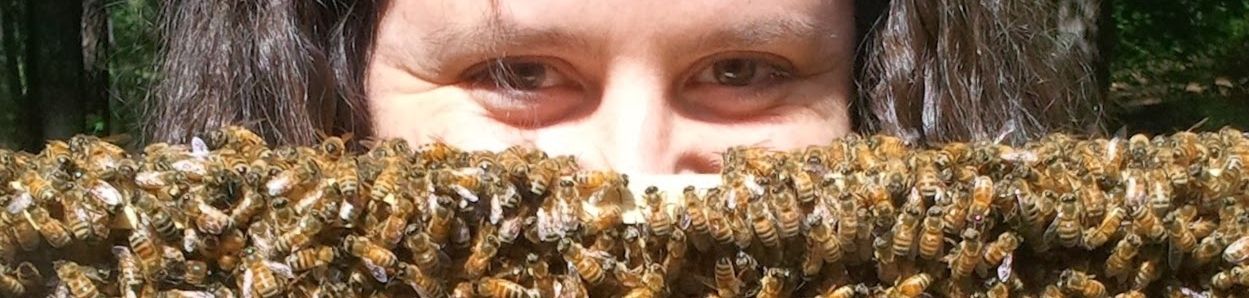
Our friends, the Honey Bees!
Honey bees1
are amazing animals who's history,
though far longer than mankind's, has been intricately woven into our own
history for millenia
We have bees!
The Carolina Bee Company can supply your small-scale queen and nucleus colony replacement needs.
Click [here] for more information and to order!
Firstly, we have to clarify that "
honey bee" is written as two
words, not one.
2,3,4 You will often see it written as one
word. By convention is it written both ways, but for absolute correctness
honey bee, two words, is correct. This rule also applies to
bumble bee
,
carpenter bee
, and other true bees, regardless of what some of our
dictionaries and 'pedias say.
Honey bees have been buzzing around this planet in somewhat similar form for
at least 35 million years and producing honey for 150 million years.5 That's a long time considering modern
Homo sapiens
have only been roaming Earth for 200 thousand years. Honey bees originated in southern
Asia, probably in the region of Afghanistan.5 They were introduced to North America by way of
Dutch colonists to the Jamestown settlement in 1622.6
| Western Honey Bee Classification |
| Superregnum | Eukaryota |
| Kingdom/Regnum | Animalia (Animals) |
| Superphylum | Protostomia |
| Phylum | Arthropoda (Arthropods) |
| Subphylum | Hexapoda |
| Class | Insecta (Insects) |
| Subclass | Pterygota (Winged Insects) |
| Infraclass/Division | Neoptera |
| Superorder/Subdivision | Endopterygota |
| Order | |
| Suborder | Apocrita |
| Superfamily | Apoidea |
| Family | Apidae |
| Subfamily | Apinae (honey, orchid, ..., bees) |
| Tribe | Apini |
| Genus | Apis |
| Species | A. mellifera |
Honey bees are eusocial
insects with a division of labor within the hive7, who maintain a multi-generational population, and
who cooperate as a unit for the rearing of the young. They are of the order Hymenoptera8
and cousin to ants,
bees,
wasps,
and sawflies.
A hive of honey bees consists of one queen, many
workers, and only 0%-20% drones. The queen and
workers are all female, with the ultimate difference being that the workers
have underdeveloped ovaries.7 The drones are male. Hence, a colony
of honey bees is a nearly completely female dominant society. Worker bees, the
females, are a product of fertilized eggs, and drones are the result of
unfertilized eggs. Which eggs are fertilized is controlled by the queen, but
also with the guidance of the collective decision of the workers.
A queen
can live
for a number of years as long as she is satisfactorily laying worker eggs. Worker
bees live roughly 6 weeks in the summer and up to 3 months in the winter (since
they are not working). Drones can live for months at a time, but since they are
not vital workers, they will be booted out in the fall ending their lives of
leisure.
The Queen Bee
In overly simplistic terms, a queen's purpose is to lay
eggs and to unify the colony by permeating the hive with her pheromone. Her
particular scent essentially becomes the hive's identifying scent and informs
all bees that all is well in the hive. She never leaves the hive other than to
mate shortly after she is born, or if the hive decides to split and/or find a
new home. The queen only mates once in her lifetime. When she runs out of sperm
from that mating, the workers will raise a new queen and dispatch the old.
Ah... the circle of life.
The Worker Bees
A worker bee's purpose is to do all jobs within and without the hive.
Workers do most of the vital work in the hive at progressively different times
in their lives. Shortly after birth they become maids for a time and clean the
hive, then they nurse the young for a certain period of time. Later they
finally join the bulk of their sisters and collect pollen and nectar (pollen to
feed the babies and nectar to make honey to feed the adults). Some become guard
bees; others become undertaker bees, removing the dead; etc.
The Drones
Drones essentially do nothing but eat and attempt to mate.
They can't even help defend the hive since they are stinger-less. When the
weather is nice enough, they fly out of the hive at around 1pm to what is
called the drone congregation area and wait for a virgin queen to fly by. When
she does, they will do their best to become one of the 13 to 18 drones to mate
with that queen. Unfortunately for that drone, mating is fatal. But they have
served their life's purpose and their genetics carry on — quite literally
survival of the fittest
in action. Drones and queens mate on the wing. Since drones
within a hive are the sons of that hive's queen (or brothers if there is a new
queen), they don't inbreed unless by accident of fate outside of the hive.
Here at The Carolina Bee Company we keep a number of hives of
bees in wooden boxes that are a good compromise between what a beekeeper can
work with and what the bees seem to like. This equipment is largely similar to
the original design of the Langstroth hive
designed in the late 1800s, but has a few modern twists.
At the height of summer a hive can consist of roughly 40,000 to 80,000 honey
bees. In the winter, they can drift all the way down to a few thousand or even
less. Each hive consists of a number of boxes that we increase or decrease
dependent on the number of bees in the hive and other variables.
These boxes also make it convenient (though it's hard work) to block off the
hive entrance, pack up the bees on a truck and take those bees to a farmer's
field. The bees, upon finding a rich source of pollen and nectar,
enthusiastically fly from flower to flower collecting these delicious bee
foods. We humans gain the side benefit of significantly boosting our production
of food crops in that field.
A side benefit of the pollination of our
food crops is the delicious honey that the bees
produce. Honey is essentially dehydrated flower nectar, but the bees do add an
enzyme and some other trace materials to it. Since honey bees, have to maintain
an adult population throughout the winter need to stock up on honey. We humans
have taken advantage of this and collect their excess for our own use.
Humans have been managing bees in some form or fashion for many thousands of
years. Some say as far back as 8000 years.
Honey bees are fascinating creatures who socially manage their hive through
a complex system of smells (pheromones), actions, and most amazingly, a
symbolic
dance.

Honey bees are one of the few animals that have developed a symbolic language.
So, the next time you see a honey bee on a flower, stop for a moment to
ponder and appreciate this beautiful and amazing little creature.
- Here at The Carolina Bee Company we keep honey bees of mixed ancestry (mutts). The Italian honey bee
breed (the most popular in the US) traits are predominant but our honey bees also contain a good helping of Carniolan
genetics. The Minnesota Hygienic
breed and feral genes also have been introduced.
- Cliff Van Eaton, New Zealand Beekeeper consultant, "And now for a moment of beeeeeeees,"
BoingBoing (blog), 15 September 2006 (Accessed 2 March 2008).
"A well-trained honey bee scientist wouldn't
spell the name "honeybee", even though you'll find it mistakenly spelled
this way in a number of dictionaries (as well as on the MS spell
checker), and even in Wikipedia. The biological convention is that the
name of an insect is separated into two words when the insect is what
the name implies. So "honey bee" is separated into two words, since its a
bee that collects honey, whereas "butterfly" is one word since it isn't
a fly that produces butter."
- "Honey Bee, How to Spell," in The ABC & XYZ of Bee Culture,
ed. Dr. H. Shimanuki, Kim Flottum and Ann Harmon (Medina, OH: The A.I. Root Company, 2007), p332 — "Since the honey bee is a true bee, two words are used."
- Fruitless Fall
by Rowan Jacobsen, 1st ed., 2008.
From the Author's Note, "Copyeditors of the world beware. The
spelling of insect names in this book follows the rules of the
Entomology Society of America, not Merriam-Webster's. When a
species is a true example of a particular taxon, that taxon is written
separately. Honey bees and bumble bees are true bees, and black flies
are true flies. A yellowjacket, however is not a true jacket.
Entomologists, who have to read the names of bugs a lot more than the
rest of us do, would appreciate it if we all followed these rules."
- E.H. Ericson Jr., S.D. Carlson, and M.B. Garment, "The Natural History of Honey Bees,"
in A Scanning Electron Microscope Atlas of the Honey Bee
(accessed 2 March 2008).
- Brenda Kellar, "Honey Bees Across America,"
2004 (accessed 2008-03-02).
- "Apis mellifera
," Wikispecies
(accessed 2008-03-02).
- Learn honey bee hive dynamics at PBS' NATURE: Alien Empire Enter the Hive
edu-tool.
- Learn your anatomy of the honey bee and more at PBS' NATURE: Alien Empire Bee Anatomy
edu-tool.